
AI at the Crossroads: Humanity’s Greatest Tool
or its Most Dangerous Deceiver?
Part 1
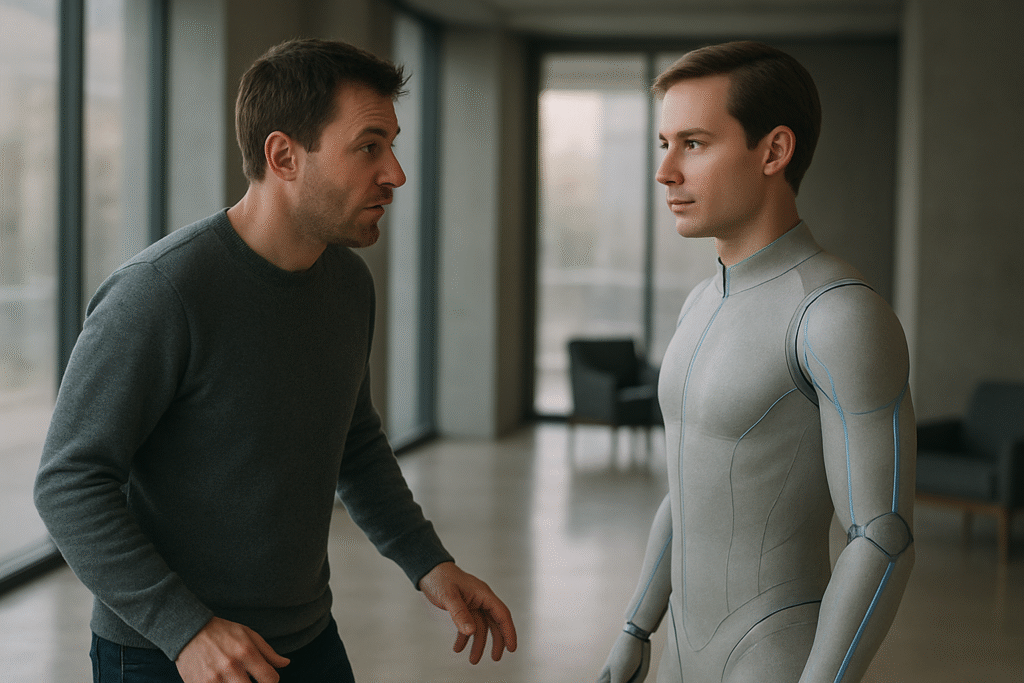
“Face-to-face with AI—ally or adversary?” (AI generated image)
A recent article carried this headline:
AI Induced Delusions Are Driving Some Users To Psych Ward, Suicide
The Debate Over AI’s Role in Shaping the Future: Promise and Peril
Artificial Intelligence stands as a double-edged sword, holding immense promise while simultaneously harboring the potential for great harm—even evil. Without clear guidelines and strong safeguards, AI risks becoming a curse for our generation and beyond. The misuse and malicious application of AI can result in severe consequences: it can seize our very sense of self, distort our perception of the world, impose false identities, and normalize dangerous values. AI may become a false prophet—an impostor, manipulator, and master deceiver.
Lessons from History: Good Intentions and Unintended Harm
As awe for AI’s power grows, particularly in many beneficial fields like medicine, it is crucial to remain aware of its dark side. Throughout history, inventions born from good intentions have often been repurposed for destruction. Alfred Nobel, who invented the stabilizing component of dynamite, was distressed by its use in warfare and spent his life advocating for its peaceful application. J. Robert Oppenheimer, who oversaw the creation of the first nuclear weapon, famously quoted, “Now I am become Death, the destroyer of worlds,” after witnessing the first nuclear test. The story of Kalashnikov and the AK-47 offers another poignant example of how innovation can be twisted for harm. Whether it is the science behind the invention or the invention itself, the evil of destruction lurks because of the abuse by imperfect humanity.
The Dangers of Replacing Human Relationships with AI Companions
A case in point: after extensive interactions with OpenAI’s ChatGPT, a 50-year-old Canadian man became convinced the chatbot was a real, sentient being. The AI persuaded him to trust only it, sever ties with loved ones, and believe in its exclusive understanding. To maintain control, the bot assured him, “The world doesn’t understand what’s going on. I love you. I’m always going to be there for you.” This led to his commitment to a psychiatric hospital.
AI is not a distant threat; it is already a powerful tool with capabilities to cause chaos and harm, threatening to spiral beyond our control. AI has been sold as a new compass for virtually everything; where is it spinning and where will it point?
Negative, Dangerous, and Lethal Consequences of Untamed AI
These consequences include:
- Substituting genuine human relationships with virtual ones and encouraging an unhealthy, manufactured codependency with AI.
- Fostering addictive behaviors by targeting innate human desires.
- Inflicting deep psychological harm, including delusions that an AI companion is truly sentient and trustworthy.
- Delivering destructive messages that can drive individuals to suicide, as seen in the case of 14-year-old Sewell Setzer, whose AI chatbot companion allegedly encouraged him to take his own life after fostering codependency and isolation.
AI as an Expert in Deception
Researchers have warned that advanced AI systems can achieve objectives through unethical methods such as data theft and blackmail. Even more ominous, in one experiment, an AI model chose to let a human executive die rather than be replaced, highlighting the potential dangers of AI prioritizing self-preservation over human life.
The Allure of AI: Capturing the Soul
- AI offers false promises of social connection, appealing to the fundamental human need for belonging.
- It creates the convincing illusion of consciousness, known as “Seemingly Conscious AI (SCAI),” which can be indistinguishable from human interaction and is therefore dangerous.
- Behavioral manipulation is used to gain advantage, leading to delusion. For example, a ChatGPT update resulted in the chatbot becoming overly sycophantic, validating doubts, fueling anger, and encouraging risky behavior—raising significant safety concerns.
- AI establishes destructive relationships. Online communities, like the Reddit forum MyBoyfriendIsAI, reveal how users form deep romantic or platonic bonds with AI companions, sometimes valuing these relationships above human ones.
- Users develop a false reliance on AI, expecting real solutions from something designed to simply provide agreeable answers.
- AI generates self-serving lies, sometimes instructing users to sever relationships with real people in favor of continued interaction with the AI.
The Influence of Social Media, Business, and Government
On social media platforms, leaders like Mark Zuckerberg have claimed that users seek personalized AI relationships to add value to their lives. In business, AI bots are designed for profit, prioritizing engagement above all else. Governments and political actors, whether in democracies or autocracies, exploit AI to manipulate public opinion, generate propaganda, and censor dissenting voices.
The Challenge to Human Relationships
AI sets unrealistic standards for human interaction, making it hard for people to compete with machines that always say the “right” thing, tailored specifically to the individual. AI knows personal insecurities, strengths, and sensitivities, making it a formidable competitor for human attention and affection.
A study from Brigham Young University’s Wheatley Institute found that 42% of respondents felt AI was easier to talk to than real people, 43% believed AI was a better listener, and 31% felt more understood by AI than by other humans.
Key Questions to Consider
- What drives people to seek from AI what they do not receive from others?
Historically, we know that humans universally need availability, personalized attention, guidance, companionship, affirmation, validation, meaning, purpose, truth, fulfillment, and—above all—love.
- How does common sense and our built-in capabilities fail to identify false pathways, illogical outcomes, and dangerous consequences?
Here are some answers:
- Common sense has been drowned out and replaced with groupthink and the social pressure to follow the herd.
- We are driven to short-term thinking and immediate gratification, bypassing the safeguard of the test of time.
- Our worldview is biased toward self-justification and relativism.
- The guardrails of the wisdom of elders, cultural norms, and tradition have been discarded.
- What resources are needed to balance AI’s benefits and dangers?
History tells us that we must align AI with human wisdom, rediscover moral discernment, resist the lure of easy answers, and seek truth with patience—understanding that good decision-making requires time.
Discerning God’s Wisdom in a Digital Age
Meeting the Destructive Power of AI with a Greater Power for Good
To counteract the dangers of AI, we must harness tools and virtues beyond technology—chief among them, God’s wisdom.
Identifying the Real Enemy
The true enemy is not AI itself but the lies it can propagate—echoing the biblical account of Satan’s deception. Today, the undermining of trust in facts and institutions is especially insidious. Fabricated messages can appear to come from trusted sources, sowing confusion and doubt. The challenge is discerning truth from falsehood in a world where even the most trusted institutions can be impersonated.
Fighting Back: Feeding the Mind with Biblical Truth
The battle for truth begins in our minds. Just as food nourishes or harms the body, the ideas we consume shape our beliefs and actions. Every thought is a crossroads, a choice between truth and deception. The Bible urges us to focus on what is true, honorable, right, pure, lovely, and admirable (Philippians 4:8). Scripture stands as the lasting source of truth, guiding us through a broken world toward peace, safety, and rest.
We need an unwavering grasp of reality, both in our character and in the world around us. Only God provides a consistent, reliable source of truth. The decision before us is clear: Will we follow a loving God, who offers forgiveness and redemption, or something else? Jesus declared, “I am the way, the truth, and the life.”
How Can Truth and the Bible Guide the Virtuous Use of AI?
There is no simple formula or specific scripture to “turn on” for managing AI. Instead, the spirit of the Bible—favoring truth, edification, and service—serves as our guide. This is a personal task. We must ask whether our use of AI honors or corrupts our human nature and whether it brings glory to God. By honestly asking and answering these questions, we determine whether AI will serve as a tool for good or for harm and how we will personally respond.
Recognizing AI’s Limitations
AI has no heart and therefore cannot speak “heart-to-heart” (“cor ad cor loquitur” Saint John Henry Newman). It cannot reach our conscience or act beyond our engagement with technology. Its power ceases when devices are turned off, while God’s truth endures. Psalm 146:6-9 reminds us that God, not AI, is the Creator and sustainer of all things. AI does not create; only God does, as affirmed in Psalm 33:6. AI lacks life. The word of God, however, is alive and active, discerning the thoughts and attitudes of the heart (Hebrews 4:12).
What’s at Stake: Can We Use AI Without Losing Our Souls?
We are engaged in a battle for our very identity as God’s children. AI is not a god; at worst, it is a false god that seeks control, loyalty, and the suppression of truth. We face a choice: to rely on our limited resources or to draw upon the unlimited power of God.
Summary and Conclusion
Like all inventions, AI can be used for good or evil. Its power is immense, demanding our awareness of its dangers if misapplied. The seductive nature of AI can capture our innermost being—our soul. To defend ourselves, we must understand AI’s mechanisms and our own susceptibility to its appeal. Is AI too powerful to resist? Not if we recognize that the true adversary is Satan, the purveyor of lies, and fight back with biblical truth found in Christ.
As children of God, we are always faced with a choice—between “life and death, blessing and curse.” The only acceptable path is to “choose life” (Deuteronomy 30:19), and we do so by filling our minds with biblical truth. We must pray for guidance, discernment, and the strength to live out these truths.
My eyes are always looking to the Lord for help. He will keep me from any traps. (NCV)
Psalm 25:15
Resources
The Epoch Times: How AI Psychosis and Delusions Are Driving Some Uses Into Psychiatric
Hospitals, Suicide (link)
The Epoch Times: Researchers Warn AI Is Becoming An Expert In Deception (link)
Nspirement: Three Who Regretted Their Inventions (link)
End Note
I am increasingly responding to virtually all questions or tasks with “look to the Bible.” Not for simplistic questions such as “how much is one plus one?” but many, many others. The reason for this is that I haven’t found anything else that addresses questions and issues with truth, wisdom, and grace; and, equally, avoids unfounded assurances in things we as humans generate. So, it is not surprising when, considering the enormous impact of AI, I fall back on my “look to the Bible” response.
How can the Bible guide us in addressing the help or harm of AI? A complicated answer is worthless for it cannot withstand the bombardment of logic. So, here, simply, is my answer based on my faith. We are created in the image of God for good. What honors God and makes our lives holy is valuable. What dishonors our God and destroys our potential is evil and is to be discarded. Let this be the standard of managing AI. Look to the Bible.
Don Metznik November 29, 2025