
Why Do People Who Do Not Believe in God Wander Into Churches?
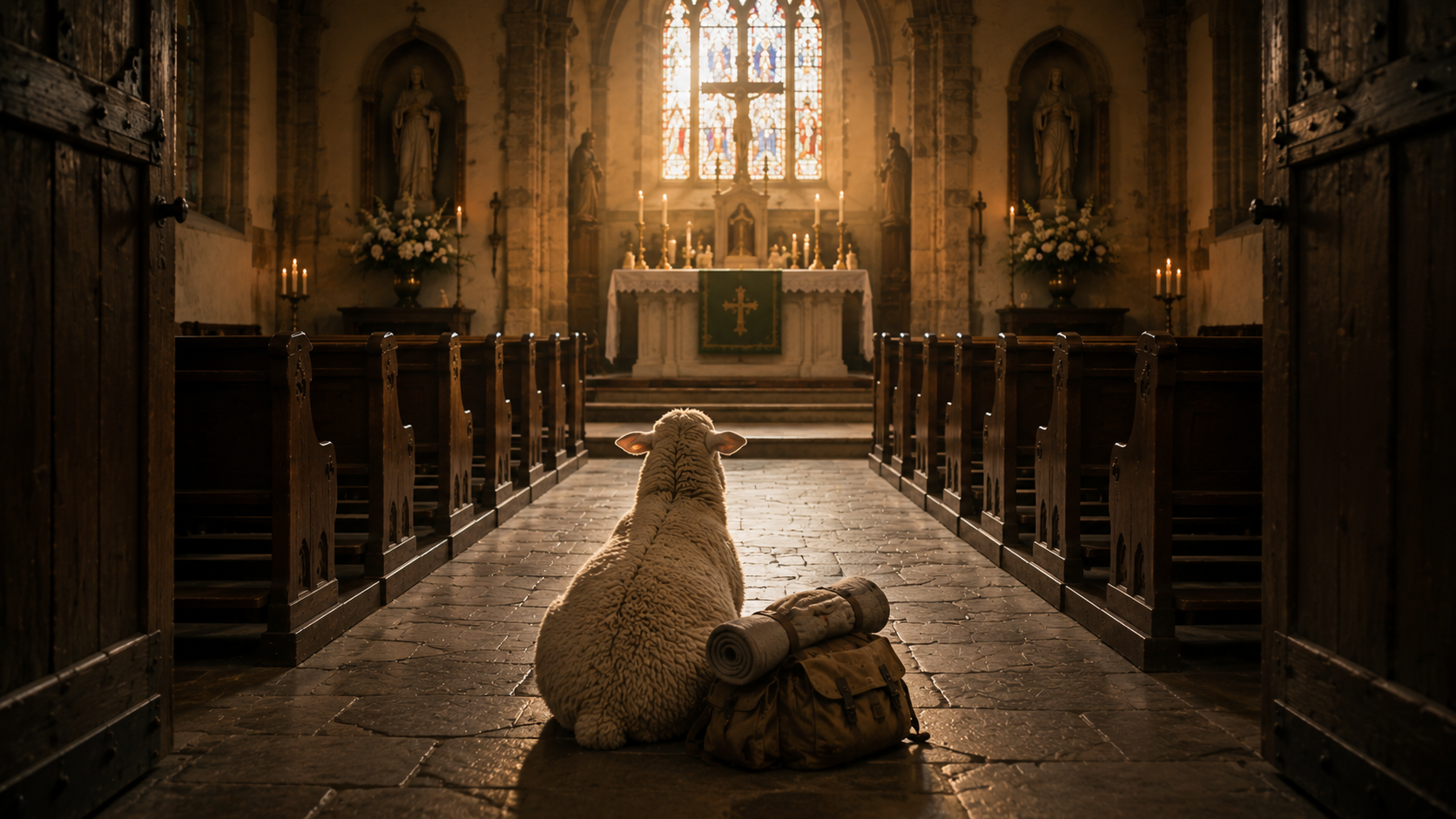
A lost sheep carrying the baggage of life wanders into a church to find a place to unburden itself.
It is a question worth pondering. In his article, “Why Do People Keep Wandering Into Empty Churches?”, Chris Palmer* suggests that people may enter because they are “carrying something heavy and have not found anywhere else to set it down.” Perhaps it is a feeling of being lost without knowing how to be found.
What might that burden be? What does it mean to set it down? And where?
Palmer observes that, despite our progress and doubts, many of us still wonder whether life offers more than achievement, distraction, and the slow passage of time. The old questions remain: Does my life have meaning? What is my purpose? Do I matter?
Those questions are not limited to people who have lost faith. People who believe also return to church carrying the same longings. In a world that can leave us discouraged, diminished, or disappointed, we still seek meaning, purpose, and a sense of worth.
The Restlessness of the Soul
In Confessions, written in 398 AD, St. Augustine famously prayed, “You have made us for yourself, O Lord, and our hearts are restless until they rest in you.” He recognized that even good things in this world cannot fully satisfy the deepest needs of the soul.
Blaise Pascal wrote of an “infinite abyss” within us—an emptiness that finite things cannot fill. His thought is often summarized as a “God-shaped vacuum” in the human heart. We may try to fill that space with success, possessions, entertainment, or approval, yet still sense that something essential is missing.
Rabbi Harold Kushner explores a similar experience in When All You’ve Ever Wanted Isn’t Enough. He considers the familiar ache of attaining success or acquiring what we hoped for, only to find that fulfillment still feels incomplete. Beneath it can lie a quiet fear: that our lives will not matter, that the world would be unchanged if we had never lived.
Long before Augustine, Pascal, or Kushner, Solomon wrote in Ecclesiastes 3:11 that God “has set eternity in the human heart.” The Amplified Bible expresses this as a sense of divine purpose and a mysterious longing that nothing under the sun can fully satisfy apart from God.
Is it this longing—something felt but not understood—that draws people into churches?
The Role of Faith
Ecclesiastes 3:11 also says that no one can fully fathom what God has done from beginning to end. That can be humbling. We do not receive an answer to every question, nor do we always see how the pieces of our lives fit together. Faith does not erase the mystery, but it gives us a way to live within it: trusting God’s character and timing while seeking what is lasting rather than what is temporary.
Scripture speaks honestly about the limits of our understanding. In Isaiah 55:8–9, the Lord says:
“For my thoughts are not your thoughts, neither are your ways my ways… As the heavens are higher than the earth, so are my ways higher than your ways and my thoughts than your thoughts.”
God’s words to Job carry a similar reminder: there is much we cannot grasp about the One who made us.
Yet Scripture also offers reassurance to those who trust Him. Jeremiah 17:7–8 describes them as a tree planted by water—steady even in seasons of heat and drought, nourished by roots that reach deeper than circumstances.
Jesus offers the clearest response to our restlessness: “I have come that they may have life and have it to the full” (John 10:10). This abundant life is not a promise that every burden disappears. It is the promise of life with Christ now, and life with Him eternally.
So perhaps we need not wander alone with what we carry. Church can be a place to pause, to ask the old questions honestly, and to set our burdens down in the presence of God and one another. To wander into being found.
(*See Chris’ article here.)